Network Routing Protocols
EEMR-PSO-CUCKOO
Certificates:PSOCUCKOO Search
Patna, BR
Storefront →Price on request
MOQ — Lead time on requestCurrency INR
Trade & shipping
Place of originIndia
BharatSeal order protection
Secure payments
Every payment is processed via Razorpay with PCI-DSS data protection and SSL encryption. We never see your card details.
PayUPIVisaMCAmexRuPayNet BankingWalletsPay Later+ more
Money-back protection
Claim a refund if your order doesn't ship, arrives damaged, or doesn't match the agreed spec. Disputes resolved within 7 working days.
Trade Assurance — not yet enrolled by this seller
This seller has not yet activated Trade Assurance. Pay outside BharatSeal at your own risk — we recommend chatting first to verify.
Only orders placed and paid through BharatSeal can enjoy free protection by 🛡 BharatSeal Trade Assurance.
Highlights at a glance
- ✓Category: Network Routing Protocols
- ✓Made in Patna, BR, India
- ✓Certified: PSO, CUCKOO Search
About this item
- Improves network lifetime through energy-efficient optimized route selection.
- Enhances bandwidth utilization for data transmission.
- Reduces End-to-End delay compared to existing protocols.
- Optimizes cluster head selection based on energy and mobility.
- Utilizes Cuckoo's Levy flight optimization for efficient path finding.
Description
An energy-efficient MANET routing algorithm that uses a hybrid approach of Particle Swarm Optimization (PSO) for cluster head selection and Cuckoo Search for optimized path finding. It aims to improve network lifetime, bandwidth utilization, and reduce End-to-End delay by considering factors like node energy, mobility, bandwidth, and distance.
Abstract
Mobility creates instability of mobile Ad Hoc networks (MANET) and uncertainty for competent routing in an unpredictable, infrastructure-less topology. Energy is one of the constraints in the MANET due to mobility and generates irregular bandwidth utilization of the networking real-time environment for changeable distance among the mobile nodes. Many researchers have proposed using PSO or hybrid PSO-ACO approaches to find an energy-efficient, stable routing path considering mobility, energy consumption, bandwidth utilization, and distance. This paper designs an energy-efficient MANET routing EEMR-PSO-CUCKOO (Energy Efficient MANET Routing Using Hybrid PSO and CUCKOO Search) algorithm. The performance analysis shows that the proposed routing protocol is more efficient and establishes a new direction than the existing one concerning network lifetime, bandwidth utilization for data transmission, and End-to-End delay. The mobility and energy environment for the PSO algorithm is applied here to create energy-efficient cluster heads by considering the additive weight-based fitness value of the individual nodes. Finally, meta-heuristic CUCKOO’s Levy flight optimization technique finds the optimized path among the cluster heads to transmit the data to the node via cluster heads. CUCKOO’s Levy fly optimization technique considers the remaining bandwidth and distance among the cluster head. Hybrid PSO and Cuckoo Search-based optimized EEMR-PSO-CUCKOO algorithm works over various MANET conditions with varying mobile nodes and CHs scenarios. Extensive simulation results show that our proposed hybrid technique improves the End-to-End delay and packet delivery ratio (PDR) in the performance of the given solution by comparing with the existing protocol ACO, PSO, Hybrid-ACO-PSO, and CSO-AODV. Further, the performance of the given key improved compared with the current protocol in terms of energy consumption or throughput and network lifetime with existing AODV, AOMDV, PSO-AOMDV, and CSO-AODV, demonstrating the dominance of the proposed algorithm.
Keywords
- PSO
- Cluster Head
- MANET
- Routing
- Energy
1 Introduction
MANETs consist of decentralized, transportation-less, distributed-autonomous mobile nodes in wireless networking that communicate among themselves without any specific topology. They are self-organizing and also self-created on demand in infrastructure-less environments. High mobility, dynamic topology, limited bandwidth utilization, and battery energy are the primary constraints of this kind of network (Abbas NI et al. 2015). In MANET, for a particular instance of time, multiple unstable paths exist due to the mobility of individual nodes. Besides mobility, the path lifetime also depends on various objectives such as noise in the transmission media, battery capacity, Euclidian distance, bandwidth utilization, etc. Considering all the purposes mentioned above and finding the optimal stable path between sources and destinations in a mobile environment of the nodes is an open, challenging issue. Hence, a fuzzy logic system (FLS) can provide a possible way for various matters related to the Quality of Services at a time (N. Fareena et al. 2020) of routing in MANET and energy conservation (K. Sudhakar et al. 2020) nodes are reduced applying clustering approach.
1.1 Related Work
In [1], K Sudhakar et al. proposed a multi-objective micro-micro clustering framework using a weight-based genetic algorithm to share secret information in military communication. It shows better results in terms of load balancing and time efficiency. In [3], Fareena N et al. suggested an ad-hoc wireless network for multi-hop communication among several mobile devices. The distributed fuzzy logic can handle uncertainties in the MANET environment. Fuzzy rules easily allow optimal route selection and route repair. It shows an increased network lifetime compared to the existing protocol MAODV. In [5], Del Valle Y et al. elaborates on the basic concepts of PSO and its various variants. PSO is applied in multiple system applications to gain optimization in the system. The designer defines the fitness function as gaining efficiency in the system. In [6], Selvakumar M et al. suggested a hybrid evolutionary algorithm for clustering. The routing process is considered an NP-hard problem, and the EECSRP model’s performance analysis is compared with that of different existing methods using parameters like end-to-end delay and packet delivery ratio. In [16], A. Ziagham et al. suggested a new vehicular ad-hoc network VANET technique to reduce the overhead of rapid cluster selection and cluster formation change. The authors use Gauss Markov Mobility (GMM) to change the protagonist rule of cluster formation and cluster member duration. In [19], Joshi, A.S et al. explain a review on meta-heuristic search using Cuckoo search techniques to solve optimization problems. Some species, like Ani and Guira Cuckoos, keep their eggs on other host bird nests and remove other eggs. They intend to hatch their eggs properly. This behavioural strategy of cuckooing with other host birds is compared and studied in detail. In [20], V. Kesavan et al. comprehensively reviewed the heuristic and meta-heuristic algorithms to solve the NP-hard problems. In this paper, shorter cellular manufacturing system (CMS) optimization is essential to achieve the best performance. Researchers discuss meta-heuristic algorithms with hybridization techniques elaborately to solve such multiple CMS problems.
The main contribution here is summarized as follows.
- Cluster formation and energy efficient cluster head (CH) selection for future data transmission.
- Increasing the whole network lifetime through energy-efficient optimized route selection.
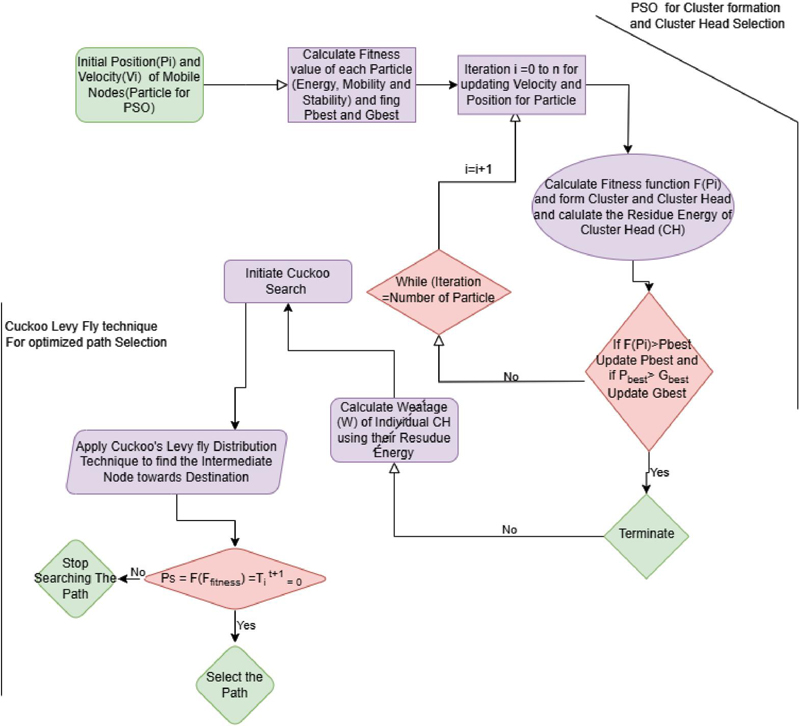
2 Modular Description of EEMR-PSO-CUCKOO
We discuss the proposed EEMR-PSO-CUCKOO algorithm in three modular parts below.
A. Cluster Formation and Cluster Head Selection using PSO
B. Packet distribution using cuckoo search.
C. Final packet transmission
2.1 Cluster Formation and Cluster Head Selection Using PSO
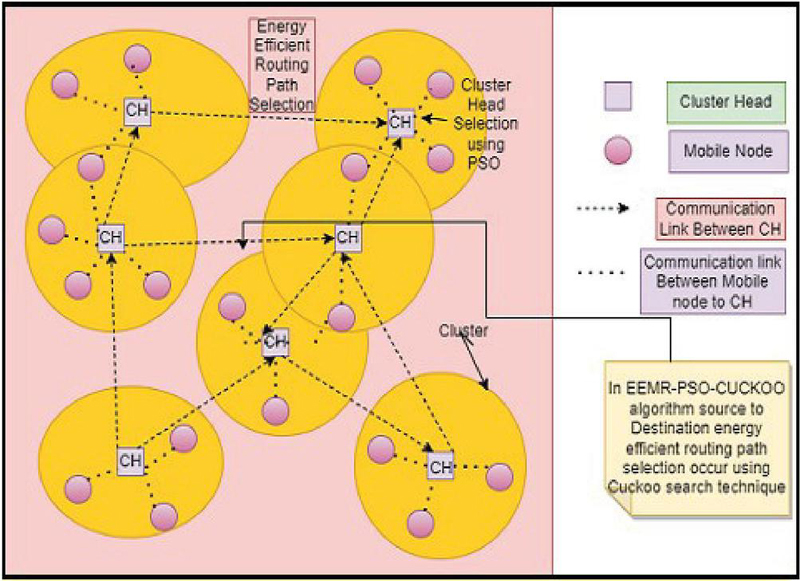
The node’s energy for cluster formation instead of the entire only some nodes initially transmit the hello message. The reply received from the neighbor node initially formed the cluster. Through the Pseudo number generator (PRNG), after the network is deployed, some selected node works as a temporary cluster head and transmit the hello message. The reply received from the neighbor node is stored in a table form by the individual cluster head and shared in their table to check if all the existing nodes reflect any of the clusters. If not, repeat the process three times by selecting different nodes as a cluster head through PNRG and trying to form the cluster. Figure 2 shows the pictorial view of the initial cluster formation with temporary cluster head selection.
The particle swarm optimization (PSO) [5, 11, 13] method finds the fitness value based on the additive weight of every node’s energy. A set of nodes forms a cluster here and searches for the optimal results through generation updates, and after each iteration so far, each node updates individual energy as Pbest. In a particular cluster, the best value obtained within the groups is Gbest among the available energy values of the individual node. Here, we consider the Gbest value for energy of the node within a cluster that belongs to the center and has minimum mobility within the collection, known as a best-fitted monitoring Cluster Head MCH, and the best fitted value is given below.
| | |
| --- | --- |
| HighestGbest(E)=>EnergyofCenterNodeNodemobility∼0 | (1) |
Here, a nodes energy (NGbest(E)) value is considered below
| |
| --- |
| NGbest(E)=HighestGbest(E)-dic+Minmobilityi+Maxi(E) |
Where,
NGbest(E) is Highest energy value of a Node that MCH cluster head belongs.
dic is ith node distance from MCH.
Minmobility is minimum mobility of a node.
Maxi(E) is maximum energy of a node.
Depending upon Pbest and Gbest values the particles update their Energy and mobility using the following equations.
| | |
| --- | --- |
| Ei(t)=(EiX(t),EiY(t)),Ei(t)energy ofith node at t time | (2) |
| Mi(t)=(MiX(t),MiY(t)),Mi(t)ith node mobility at time t | (3) |
[](https://journals.riverpublishers.com/index.php/JMM/article/download/30195/22349?inline=1#rS2.F2)
**Figure 2** Graphical representation of Cluster formation and temporary CH selection.
Considering energy and mobility of a node the fitness function using PSO is computed here as per the proposal in Equation (4) below
| | |
| --- | --- |
| Ei(t+1)=(Epbesti(t+1)=Ei(t)+Miupdate(t+1) | (4) |
As we know the mobility at time t would be,
| | |
| --- | --- |
| Mupdate(t)=>(ResudueEnergy(R)Mobility(M)) | (5) |
Where the mobility updating will be,
| | | |
| --- | --- | --- |
| Mupdatei(t+1) | =wMi(t)+c1*rand()
*(EPbesti-Ei(t)) |
| | +c2*rand()
*(EGbest-Ei(t)) | (6) |
For our proposal in a Cluster the EGbest is best fitted monitoring cluster head energy that would be ideal if it placed at the center of the cluster and will consider as Gbest value. The best fitness value for cluster head (CH) is consider as
| | |
| --- | --- |
| EGbestMax(t)=>MaximumEnergy(Emax)LowestMobility(Lmob) | (7) |
For global update fitness value for a node with CH the difference of energy would be for a node is given below as
| | |
| --- | --- |
| EGbest[t+1]=EGbestMax(t)-Eupdate[t+1] | (8) |
| Eupdate[t+1]=dci+min(mobility)+RRes_max(Energy) | (9) |
Where,
dci = distance of a node from cluster head.
min(mobility) = as minimum as possible mobility for a node.
RRes_max(Energy) = Maximum possible residue energy.
Here, Eupdate[t+1] is node energy in the existing position of the particle and rand() function is considered here as a random number value lies between (0,1), where c1 and c2 are the learning factors, and the measurement value is 2 for both. Maximum energy Emax needs to calculate the nodes of each dimension for the mobility of the nodes. As shown in Figure 1, the updating process is continual until a satisfactory value in the CH is given below.
| | |
| --- | --- |
| CH(t+1)i={CHi(t)if((Pbesti(CHi(t))>Fitness(Pbesti(node_i(t+1))))Pbesti(node_i(t+1)otherwise. | (10) |
#### 2.1.1 Fitness function
The observation here in the proposed model is that the fitness function depends on the average intra-cluster distance and average distance among the mobile nodes, which is given below in Equation (11)) The main objective for optimal CH selection is to make minimization of middle intra-cluster and average migratory distances of all the CHs. Thus, the first objective of the CH selection process here in Equation (11)).
| | |
| --- | --- |
| ffirst=∑j=1m1lj(∑i=1ljD(Si,CHj)+D(CHi,CHj)). | (11) |
#### 2.1.2 Energy parameter
ECHj is jth selected CH’s present total energy, among the mobile nodes in an iteration process. where, 1 ≤ j ≤ m. The optimal energy uses during cluster head selection is required to utilize as minimize as possible energy values of the mobile nodes in between the iteration, which is given below by Equation (12)).
| | |
| --- | --- |
| Minimizefsecond=1∑j=1m(ECHj) | (12) |
Here, minimize of the above objectives that used and fitness function that produces shown in Equation (13)).
| | |
| --- | --- |
| ffitness=α×ffirst+(1-α)×fsecond0<α<1 | (13) |
Now, as per the algorithm [1], after finding the CHs within an individual CH’s region, the data has to be transmitted by the mobile node through their respective CH in which cluster they are in on that particular instance of time. Finally, the cluster formation occurs by the CHs to residue energy, the distance among the mobile nodes within CHs, the space among the cluster heads and the degree of CH’s node combining this Equations (14)) and (15)) are defined as the respective energy of CHs. Finally, the respective energy of CHs is given below.
The respective energy of CHs.
| | |
| --- | --- |
| CHweight(si,CHj)∝CurrentResidueEnergy(RH)dis(si,CHj)×dis(CHi,CHj)×node_degree(CHj) | (14) |
| CHweight(si,CHj)=L×RHD(si,CHj)×D(CHj,CHj)×node_degree(CHj) | (15) |
| |
| --- |
| **Algorithm 1** Finding CH using PSO |
| 1. **Input:** n number of mobile node<br>2. **Output:** Formation of Cluster and Cluster Head<br>3. **Begin Process**<br>4. **for** Each mobile node _m = 1_ to _n_ **do**<br>5. Initialize Ei for Mobile Node (Em1,Em2,…,Emn)<br>6. **end for**<br>7. **End**<br>8.<br>9. **repeat**<br>10. **for** m=1 to _n_ **do**<br>11. Calculate _ffitness_ for individual mobile node<br>12. **if** ffitness>Gpbest **then**<br>13. Set ffitness as current Gpbest<br>14. **else**<br>15. Gpbest is current Gpbest<br>16. **end if**<br>17. **end for**<br>18. **while** _CH_ not found within _si_ **do**<br>19. **end while**<br>20. **until** condition is met 21.<br>21. **for** each _CH_ **do**<br>22. **if** EGbest is not found **then**<br>23. Calculate ffitness for EGbest for all _CH_<br>24. **else if** ffitness(EGbest)>EGbest **then**<br>25.
[…page truncated…]
Key attributes
Trade & shipping terms
Set by CUCKOO CREATIONS PRIVATE LIMITED — the supplier's own terms.
Certificates
PSO
CUCKOO Search
Reviews
Questions & answers
Ask the supplier — answers are visible to all buyers
No questions yet. Be the first to ask!
Know your supplier
CUCKOO CREATIONS PRIVATE LIMITED
Unverified<1 yr on BharatSealPatna, Bihar
Orders completed
—
On-time delivery
—
Reorder rate
—
Year founded
2025
Staff size
—
Certifications
2