Mass Transfer Equipment
SCM STRUCTURED PACKING
Pune, MH
Storefront →Price on request
MOQ — Lead time on requestCurrency INR
Customization for this product
Available in various metals and corrosion-resistant materials.
BharatSeal order protection
Secure payments
Every payment is processed via Razorpay with PCI-DSS data protection and SSL encryption. We never see your card details.
PayUPIVisaMCAmexRuPayNet BankingWalletsPay Later+ more
Money-back protection
Claim a refund if your order doesn't ship, arrives damaged, or doesn't match the agreed spec. Disputes resolved within 7 working days.
Trade Assurance — not yet enrolled by this seller
This seller has not yet activated Trade Assurance. Pay outside BharatSeal at your own risk — we recommend chatting first to verify.
Only orders placed and paid through BharatSeal can enjoy free protection by 🛡 BharatSeal Trade Assurance.
Highlights at a glance
- ✓Category: Mass Transfer Equipment
- ✓Made in Pune, MH, India
Description
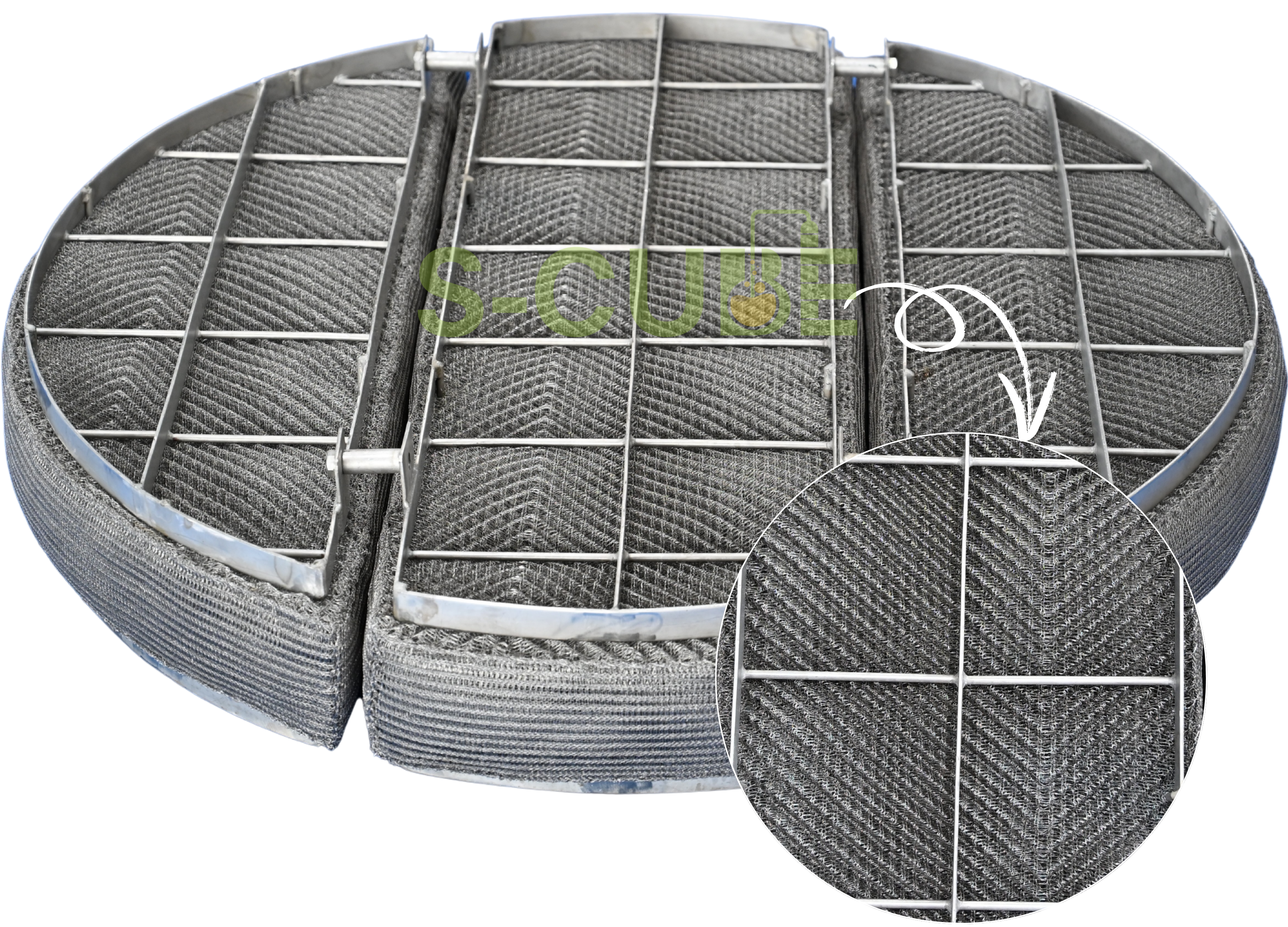
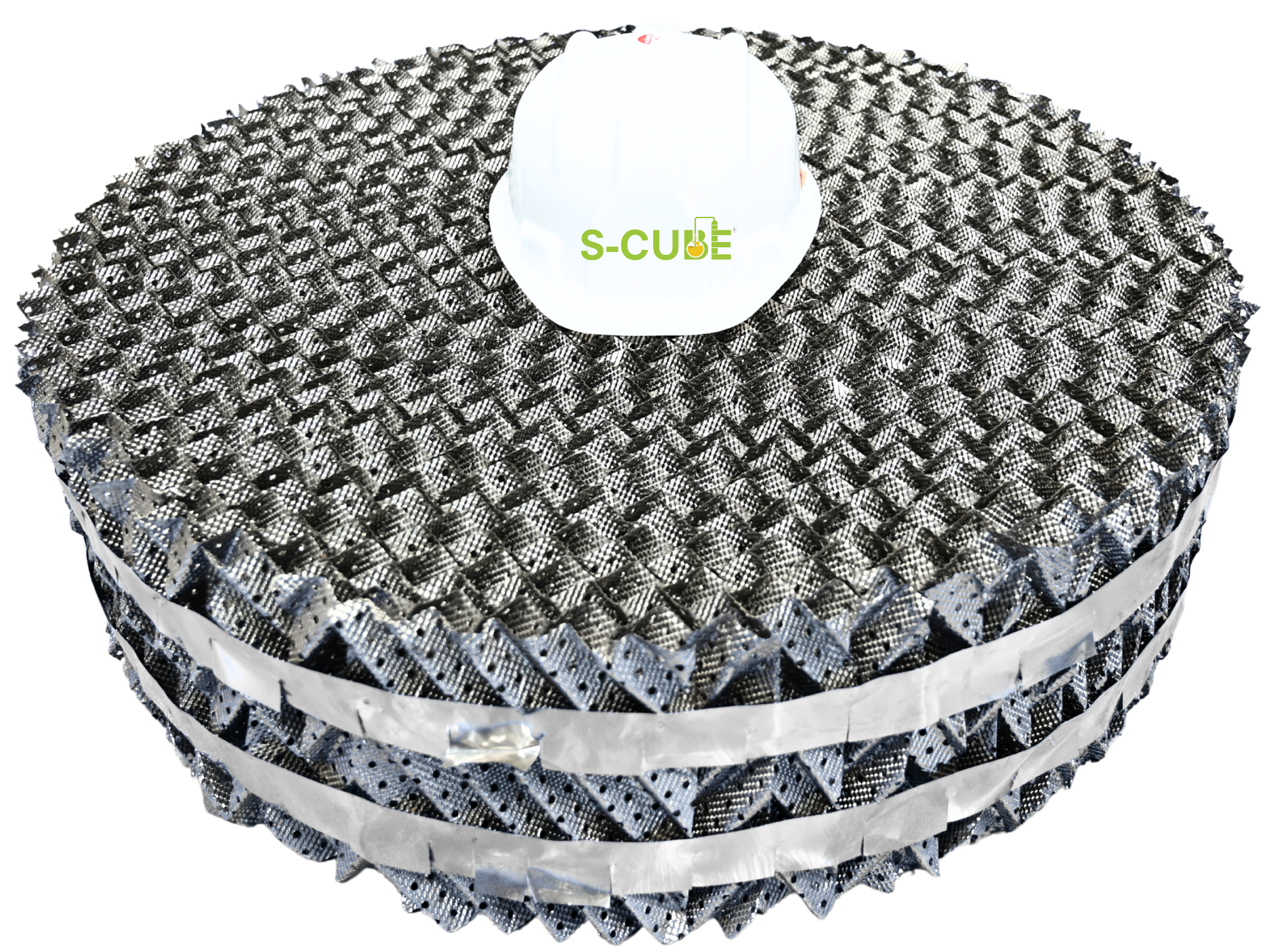
With decades of experience in structured packing development and manufacturing, S-Cube offers optimized mass transfer solutions. Our portfolio ranges from traditional sheet metal packing to advanced high-capacity designs, engineered for superior efficiency, lower pressure drop, and enhanced separation performance. Available in various metals and corrosion-resistant materials.
SCM Structured Packing & Internals Installation Guide
SCM Structured Packing & Internals Installation Guide - YouTube
Tap to unmute
[SCM Structured Packing & Internals Installation Guide](https://www.youtube.com/watch?v=9FogpWm8_2k)
[S Cube Mass Transfer Pvt Ltd](https://www.youtube.com/channel/UCDUYfxFrwEKaIuhoUzIpGZg)
S Cube Mass Transfer Pvt Ltd73 subscribers
[Watch on](https://www.youtube.com/watch?v=9FogpWm8_2k)
Types of Structured Packing We Offer
- SCM- Sheet Metal Structured Packing - Higher Capacity: Reduced gas velocity at packing interfaces minimizes premature flooding, allowing increased throughput. - Lower Pressure Drop: Smooth vapor transition reduces shear forces and stabilizes liquid films.
- S-Cube Wire Gauze Structured Packing Optimized for High-Efficiency Separation - High number of theoretical stages per unit height - Pressure drop per theoretical stage 0.1-0.5 mbar - Minimum liquid load approx. 0.05 m3/m2h - Small hold-up
- S-Cube Laboratory Packing For small laboratory columns - Laboratory columns from 25 to 150 mm - Vacuum from 1 mbar - Where a high number of theoretical stages is required - Distillation of components prone to decomposition
- S-Cube Structured Grid Packing - Not sensitive to coking and fouling due to its smooth surface and geometrical structure - Efficient dissipation of temperature - Better de-entrainment and separation efficiency than a traditional grid - The low element height and its structure allow for easy cleaning. It can be removed, unscrewed and cleaned with a water jet - Mechanically robust structure
- Non-metallic Structured Packing For Corrosive Applications - Excellent surface wetting ability, larger mass transfer area, and higher separation efficiency owing to the special surface structure; - High compressive strength; - Little magnifying effect - More fields/conditions to be applicable
FAQs
### What is structured packing and how does it differ from random packing?
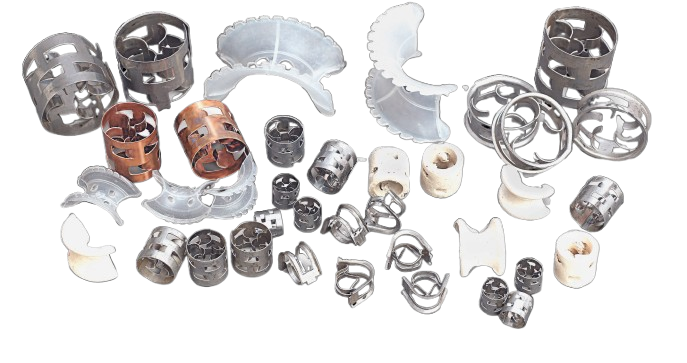
Structured packing consists of corrugated sheets or wire mesh arranged in a specific geometric pattern, providing uniform flow distribution and predictable performance. Unlike random packing (which uses loose pieces), structured packing offers lower pressure drop, higher separation efficiency, better capacity, and more consistent performance due to its organized geometry.
### What factors should I consider when selecting structured packing for my application?
Key selection factors include: operating pressure (vacuum vs atmospheric), required number of theoretical stages, allowable pressure drop, liquid and vapor flow rates, system corrosivity (determining material choice), fouling tendency, and column diameter. The F-Factor, NTSM (Number of Theoretical Stages per Meter), and surface area are critical performance parameters to evaluate.
### What is the F-Factor and why is it important in structured packing selection?
The F-Factor is a capacity parameter calculated as the vapor velocity multiplied by the square root of vapor density. It indicates the maximum vapor loading capacity of the packing. Lower F-Factor values (like 1.2-1.5) indicate higher capacity packing suitable for high-throughput applications, while higher values (2.0-2.6) are used for applications requiring more theoretical stages with lower capacity.
### When should I choose wire gauze structured packing over sheet metal packing?
Wire gauze structured packing is preferred when you need maximum separation efficiency with very low pressure drop per theoretical stage (0.1-0.5 mbar). It's ideal for vacuum distillation, applications requiring high NTSM values (6-9 per meter), and systems with low liquid loads (minimum ~0.05 m³/m²h). Sheet metal packing offers higher capacity and is better for high-throughput applications.
### What are the advantages of high-capacity (HC) structured packing variants?
High-capacity structured packing variants feature optimized geometry that reduces gas velocity at packing interfaces, minimizing premature flooding. This allows for increased throughput and higher production rates. HC variants also typically offer lower pressure drop while maintaining good separation efficiency, making them ideal for revamp projects where capacity increase is the primary goal.
Key attributes
Trade & shipping terms
Set by S-CUBE MASS TRANSFER PRIVATE LIMITED — the supplier's own terms.
Reviews
Questions & answers
Ask the supplier — answers are visible to all buyers
No questions yet. Be the first to ask!
Know your supplier
S-CUBE MASS TRANSFER PRIVATE LIMITED
Unverified<1 yr on BharatSealPune, Maharashtra
Orders completed
—
On-time delivery
—
Reorder rate
—
Year founded
2011
Staff size
—
Certifications
—