Mass Transfer Equipment
RANDOM PACKING
Pune, MH
Storefront →Price on request
MOQ — Lead time on requestCurrency INR
Customization for this product
Our engineers and technical team use the latest materials and design methods to create packing solutions that fit your exact process needs.
BharatSeal order protection
Secure payments
Every payment is processed via Razorpay with PCI-DSS data protection and SSL encryption. We never see your card details.
PayUPIVisaMCAmexRuPayNet BankingWalletsPay Later+ more
Money-back protection
Claim a refund if your order doesn't ship, arrives damaged, or doesn't match the agreed spec. Disputes resolved within 7 working days.
Trade Assurance — not yet enrolled by this seller
This seller has not yet activated Trade Assurance. Pay outside BharatSeal at your own risk — we recommend chatting first to verify.
Only orders placed and paid through BharatSeal can enjoy free protection by 🛡 BharatSeal Trade Assurance.
Highlights at a glance
- ✓Category: Mass Transfer Equipment
- ✓Made in Pune, MH, India
Description
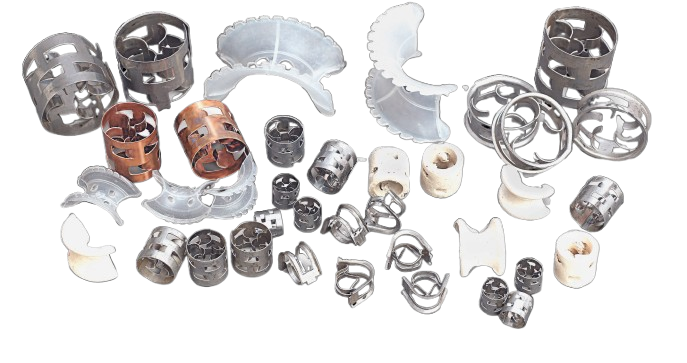
Trusted supplier of high-efficiency random packings for oil & gas, chemicals, and refineries. Our packing materials improve mass transfer by increasing surface area and contact between phases. Ideal for systems with fouling or corrosion, easy to replace and store. We offer Metal Pall Rings, Plastic Pall Rings, Ceramic Saddles, Raschig Rings, and Intalox Saddles, each designed for specific applications and operating conditions.
Process Advantages of Random Packing
- Reduced pressure drop through the column.
- Reduced liquid hold up through the column.
- Variety of packing types for different types of processes.
- Higher capacity compared to trays at same efficiency.
- Good performance in fouling conditions.
Types of Tower Packing
- Raschig Ring The Raschig ring is a piece of tube that is used in large numbers in a packing column. Raschig rings are usually made of ceramic or metals, and they provide a large surface area within the column, allowing for interaction between liquid and gas vapors. Read more
- Pall Ring Pall rings are the most common form of random packing. Pall rings have similar cylindrical dimensions but has rows of windows which increase performance by increasing the surface area. They are suited for low pressure drop and high capacity applications. Read more
- IMTP Saddles S-Cube Mass Transfer is India's leading manufacturer, supplier, and exporter of random packing, pall rings packing & IMTP packing. Our extensive portfolio offers ceramic pall rings, plastic pall rings, metal pall rings, metal intalox saddles, ceramic intalox saddles, polypropylene intalox saddles, PVDF intalox saddles & more. Read more
- Non-Metallic Random Packings Non-metallic random packings have been successfully and inexpensively used to increase tower capacity and efficiency. The process advantages of plastic random column packing include being less bulky than ceramic equivalents and offering higher capacity and lower pressure drop. Read more
FAQs
### What is random packing?
Random packing consists of small, discrete units that are randomly dumped into a column to create a large surface area for mass transfer. It's used in distillation, absorption, and stripping operations.
### What are the different types of random packing available?
We offer various types including Metal Pall Rings, Plastic Pall Rings, Ceramic Saddles, Raschig Rings, and Intalox Saddles, each designed for specific applications and operating conditions.
### How does random packing compare to structured packing?
Random packing is generally more cost-effective and easier to install, while structured packing offers higher efficiency and lower pressure drop. The choice depends on your specific requirements, budget, and operating conditions.
### What materials are available for random packing?
Random packing is available in various materials including stainless steel, carbon steel, plastic (PP, PVC, PTFE), and ceramic, each suitable for different chemical compatibility and temperature requirements.
### How do I choose the right random packing for my application?
Selection depends on factors such as column diameter, operating pressure and temperature, chemical compatibility, required efficiency, and budget. Our engineering team can help you select the optimal packing type and material.
### What is the typical installation process for random packing?
Random packing is installed by simply dumping the packing units into the column. It's important to ensure proper distribution and avoid segregation by size. Support grids and hold-down plates are typically used to maintain packing position.
Key attributes
Reviews
Questions & answers
Ask the supplier — answers are visible to all buyers
No questions yet. Be the first to ask!
Know your supplier
S-CUBE MASS TRANSFER PRIVATE LIMITED
Unverified<1 yr on BharatSealPune, Maharashtra
Orders completed
—
On-time delivery
—
Reorder rate
—
Year founded
2011
Staff size
—
Certifications
—